

ABOUT US
There are two primary types of ice-making technologies for ice rinks: direct evaporation ice-making technology and ethylene glycol indirect evaporation ice-making technology. Backed by Asirui’s exclusive direct evaporation ice-making technology, the solution boasts remarkable energy-saving advantages over ethylene glycol indirect evaporation ice-making systems and can effectively manage the total power consumption of standard ice rinks. It frees ice rink investors from the burden of excessive energy use and drastically cuts ice rink operating costs.
Beyond high efficiency, energy conservation and superior environmental performance, the ISREL ice-making system features fast ice formation, low civil engineering costs, compact machinery room footprint and premium ice quality:
- Fast ice formation: For an international standard ice rink, the system can rapidly form competition-compliant ice surfaces after startup, with low overall energy consumption throughout the whole process.
- Low civil engineering costs: The required foundation trench depth is merely 300 millimeters, and no pipe trenches are needed along the venue edges.
- Compact machinery room footprint: The equipment room occupies only 18 square meters.
- Premium ice quality: Powered by eco-friendly refrigerant direct evaporation ice-making technology, the system delivers consistent ice temperature across the entire rink for outstanding ice quality. The direct evaporation ice-making system follows a physical characteristic of one corresponding temperature per pressure level, allowing it to quickly reach the precise ice temperatures required for various ice sports.
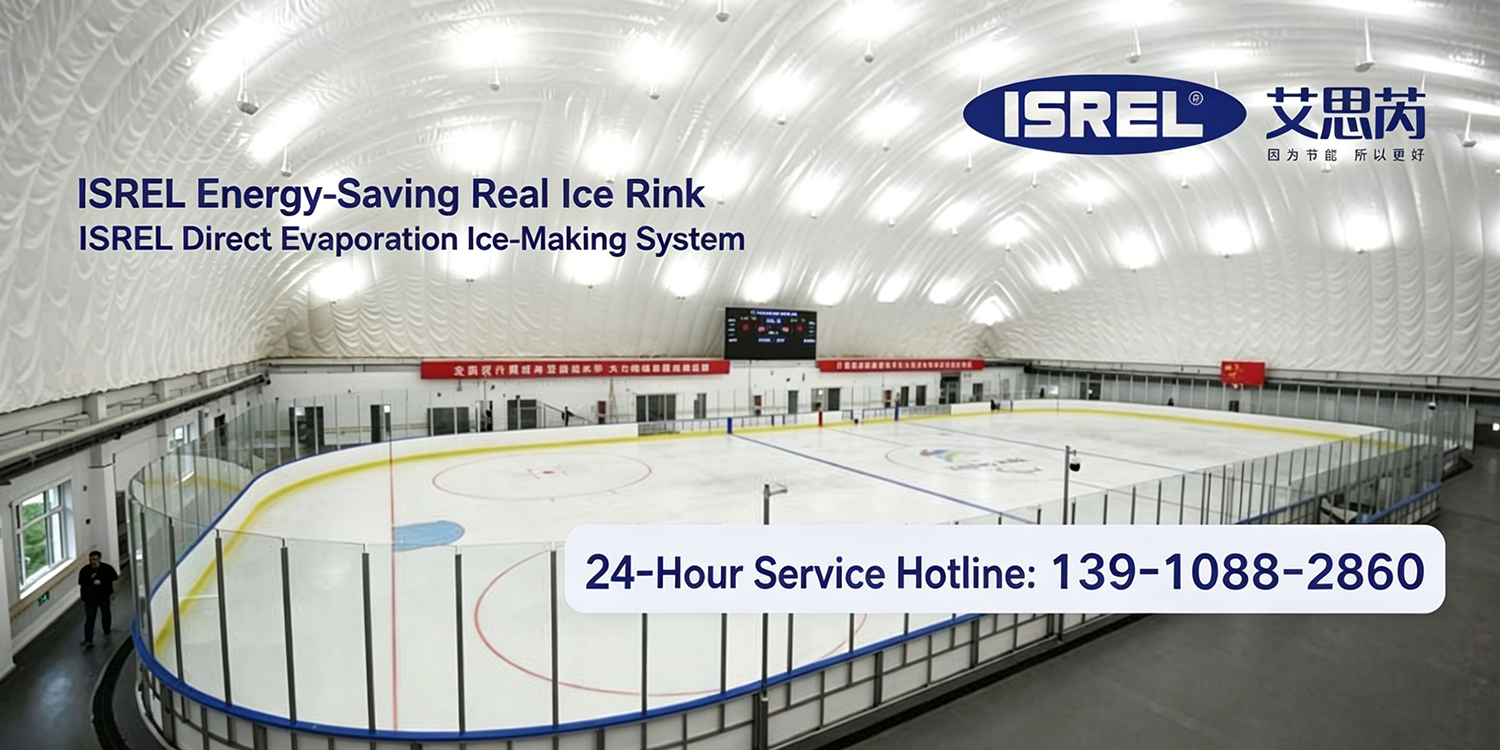
Excellent refrigeration startup efficiency with a short ice forming cycle. Compared with traditional ethylene glycol ice-making systems, the total time required to produce competition-standard ice is greatly reduced, delivering a prominent edge in ice formation speed.
The main refrigeration header pipe running from the ice-making unit to the rink floor is extremely short, with a standard minimum design length of only 0.8 meters (while competitors’ solutions extend to 300–400 meters). No water pumps are deployed throughout the entire ice-making system, eliminating cold loss caused by water pumps and enhancing the system’s maintenance-free performance. The ice-making system requires no water supply or drainage connections, serving as a core guarantee for superior environmental performance.
The system achieves a one-to-one correspondence between pressure and temperature, ensuring uniform ice surface temperature and premium ice quality.
Safe & Eco-Friendly: Adopts environmentally friendly refrigerants. Seamless steel pipes are used for the rink floor piping, featuring high heat transfer efficiency and a long service life. By contrast, ethylene glycol systems employ PE pipes with shorter lifespans and high thermal resistance.
No valves, exposed pipes, cable trays or messy components of any size are visible inside the ice machine room. Only one single main refrigeration header pipe is installed, manufactured via patented manifold sleeve assembly technology.
Air Dome Ice Skating Rink
Air-supported membrane ice rinks are inflated by air pressure. Compared with conventional ice and snow sports venues, they cut down water resource consumption and environmental pollution.
No construction waste is generated during the manufacturing and installation of the membrane structure. The construction site produces no noise or environmental contamination. The inflatable structure creates a vast interior space with minimal resource input.
The venue can be relocated and resized as required, boasting strong adaptability. It delivers more flexible and convenient solutions for events and exhibitions.
Air-supported membrane buildings feature low construction costs, short design and construction cycles, and outstanding green energy-saving performance. The self-weight of an air membrane building is merely about 3 kilograms per square meter. The architectural membrane material is detachable and reusable.
Air-supported membrane gymnasiums are equipped with a complete air circulation and purification system, which effectively blocks outdoor dust and suspended particles to maintain a clean, comfortable indoor sports environment at all times.
Thanks to the excellent air tightness of the membrane structure together with the fresh air system, haze and dust from outside cannot seep into the venue through gaps around doors and windows, guaranteeing superior indoor air quality.
Company Establishment
2018
+

Registered Capital
20
million RMB

Workshop Area
18000
㎡

On-Site Staff
200
+


